OLE Controls (Germany): Difference between revisions
Jump to navigation
Jump to search
No edit summary |
Signalsoft (talk | contribs) No edit summary |
||
| (8 intermediate revisions by one other user not shown) | |||
| Line 1: | Line 1: | ||
Typical Overhead Line Equipment (OLE) in Germany | Typical Overhead Line Equipment (OLE) control panels in Germany consist of two buttons per circuit breaker. These buttons are labelled "E" for "on", and "A" for "off". A blue label beneath the buttons indicates the breaker number. | ||
If the breaker is disconnected, pressing the "E" button closes the breaker. Conversely, if the breaker is connected, pressing the "A" button opens the breaker. If the breaker is closed and excess current is detected, the breaker will open automatically and is said to be "tripped." | |||
Additionally, these controls have caps that are placed over top of the buttons to prevent accidental operation in cases where there may be engineering work underway. These caps are yellow and have "Nicht Schalten" printed on them. | |||
<gallery> | |||
File:Catenary_controls_off_de.png|Off (open circuit). | |||
File:Catenary_controls_on_de.png|On (closed circuit). | |||
File:Catenary_controls_tripped_de.png|Breaker has tripped. | |||
File:Catenary_controls_danger_de.png|danger label applied. | |||
</gallery> | |||
Latest revision as of 07:38, 18 January 2011
Typical Overhead Line Equipment (OLE) control panels in Germany consist of two buttons per circuit breaker. These buttons are labelled "E" for "on", and "A" for "off". A blue label beneath the buttons indicates the breaker number.
If the breaker is disconnected, pressing the "E" button closes the breaker. Conversely, if the breaker is connected, pressing the "A" button opens the breaker. If the breaker is closed and excess current is detected, the breaker will open automatically and is said to be "tripped."
Additionally, these controls have caps that are placed over top of the buttons to prevent accidental operation in cases where there may be engineering work underway. These caps are yellow and have "Nicht Schalten" printed on them.
-
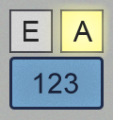 Off (open circuit).
 -
 On (closed circuit).
 -
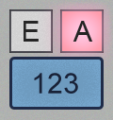 Breaker has tripped.
 -
 danger label applied.


