OLE Controls (Netherlands): Difference between revisions
Jump to navigation
Jump to search
Created page with 'Typical Overhead Line Equipment (OLE) control panels in the Netherlands consist of a single knob per circuit breaker. Catenary connectors that can open automatically (i.e., they …' |
No edit summary |
||
| Line 7: | Line 7: | ||
<gallery> | <gallery> | ||
File:Catconnector_off_gray.png|Non-trippable connector in "off" position. | |||
File:Catconnector_on_red.png|Trippable connector in "on" position. | |||
File:Catconnector_tripped_red.png|Tripped connector. | |||
File:Catconnector_off_gray_danger.png|Connector with danger label applied. | |||
</gallery> | </gallery> | ||
Latest revision as of 04:04, 17 November 2010
Typical Overhead Line Equipment (OLE) control panels in the Netherlands consist of a single knob per circuit breaker. Catenary connectors that can open automatically (i.e., they can trip) are red while ordinary connectors are grey.
If the breaker is closed and excess current is detected, the breaker will open automatically and is said to be "tripped."
Additionally, these controls have red tags that are placed onto the knobs to prevent accidental operation in cases where there may be engineering work underway. These tags are red and have "Gevaar", meaning "Danger" printed on them.
-
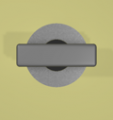 Non-trippable connector in "off" position.
 -
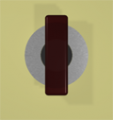 Trippable connector in "on" position.
 -
 Tripped connector.
 -
 Connector with danger label applied.


